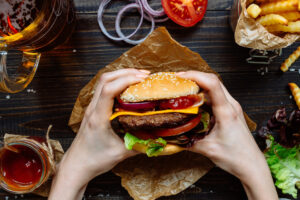
The introduction of a periodic cheat-meal is common practice among fitness enthusiasts, but not only, when they find themselves in a phase of greater dietary restriction with the aim of losing weight and fat mass. Or whenever they're on a strict diet for some other purpose. A study with a sample of young adults tells us of a prevalence of over 85% when we define it broadly as the premeditated ingestion of some food outside the planned diet. An analysis of images posted on Instagram with the hashtag #cheatmeal estimates an energy intake of up to 9,000 kcal in a single meal. Men have the ability to eat twice as many calories as they need to feel satiated, when the aim is to eat without restriction. This behavior is widely shared in profiles that show stereotypical "fit" bodies and associate them with benefits for body composition. The truth is that there is no evidence that cheat–meal has any positive impact on this level, and can even be a trap for those trying to lose weight. The calories in cheat-meal also count.
First of all, it is important to define cheat-meal which, as the literal translation suggests, is a "cheat meal" - a meal outside of the established regular diet and which allows us to eat foods we like but restrict ourselves to the rest of the time. The frequency of this meal can vary, but the most common is once a week. A cheat-meal is not a cheat-dayA "cheat day" doesn't even mean that it drags on for hours on end. Like those family get-togethers that start at lunch and end at dinner. Some people do it that way, but it's neither the most common nor the most recommended. And although you do take advantage of this meal to eat "shit", or foods that are appreciated in this way, you don't write "shit-day" as I often read on social media.
In defense of cheat-meal essentially two main aspects are alleged:
1) It allows us to include foods we like and makes it easier to stick to them, relieving the perception of restriction and feelings of guilt. It creates space for socializing with others;
2) It promotes a kind of "reset" to the metabolic adaptations caused by energy restriction, by accelerating metabolism and reversing the hormonal changes resulting from weight loss.
With regard to the first, there is some room for ambiguity in interpretation. I admit that in some cases it can relieve the psychological stress of a restrictive diet, but then the problem lies in the diet and the way it is viewed. As an obligation and sacrifice rather than a positive. A path to a goal that in itself brings benefits. And it doesn't have to be a penance, nor is it necessary to exclude everything we like. Educated flexibility is a behavior associated with a successful diet and greater adherence. A cheat-meal is anything but. It is the exacerbation of a rigid model that advocates value judgments in relation to food. A dichotomous assessment between good and bad, permitted and forbidden, which does not encourage a healthy relationship with food and which can in some cases manifest itself as a disorder. Despite finding aspects in these free meals that are associated with a diagnosis of binge eatingHowever, psychological stress doesn't seem to be present due to the perception of greater control over behavior and without the shame typically felt. However, we often find compensatory rituals, such as increased physical activity the following day, greater calorie restriction a posteriori, or taking supplements that aim to mitigate the impact of a larger meal.
Eating behavior is a complex phenomenon dictated by involuntary homeostatic mechanisms, but also by pleasure, reward and cognition. Homeostatic mechanisms are those that meet actual energy needs. If I need energy, I'm going to be hungry and I'm motivated to make the motor response that leads to seeking out and consuming the meal. The executive brain areas, the hypothalamus and the brainstem, regulate these mechanisms through inputs internal signals that signal this need for energy. In a perfect system, this regulation would keep weight stable without much effort through a balance between need and hunger. We would eat when and how much we need. But Nature has complicated our lives to defend the species, creating mechanisms that override homeostasis to allow the creation of reserves in an environment of abundance, which is very recent in our evolutionary history of scarcity, effort to obtain food, and intermittent periods of plenty. The time was right for reserves to be created, and for this to happen we need mechanisms that make it easier to eat in excess, even at full energy. This is where hedonic hunger comes in, mediated by pleasure and reward. Pleasure is actually a conserved and powerful mechanism for motivating behaviors that are essential for survival. All animals without exception seek strategies to maximize it. I'm talking about eating to live or sex to reproduce and ensure the persistence of our genes. These are two behaviors that evolution has associated with pleasure precisely so that we seek them intensively.
The reward or gratification that a food gives us depends on its composition and the associative memories we have created in past experiences. There are three nutrients that satisfy this hedonic hunger more and promote a greater response from the reward centers, our mesolimbic system, which I'll present in more detail in a moment. These are sugar, sweets, and rapidly assimilated carbohydrates, saturated fat and salt. Individually, they don't seem that interesting to us, nor would they make a "good" cheat-meal. Few people think it's funny to eat sugar by the spoonful, or lard. Even less. But combine them and we have highly palatable foods. Pizza, cakes, cookies, potato chips, you name it. It's not fish and chips or chicken and rice that make it cheat-mealsNot only because they fit in with the "good" foods, but also because they don't arouse the same pleasure and desire for the vast majority of people.
The limbic system is central to the motivation of behaviors associated with obtaining a reward and the size of the incentive. In particular, two of its structures, the ventral tegmental area (VTA) and the nucleus accumbens (NAc). What we call the mesolimbic system. The NAc is important for goal-directed behavior, instrumental learning and behavioral flexibility. We have Pavlov's classic experiment as an example. The dog salivates when the doorbell rings after having been conditioned by food. So many times did he receive reinforcement when the bell rang, the food, that it was enough for him to ring it to anticipate the response and salivate. Before even seeing the food. The NAc then translates motivation into a motor action through another structure, the pallidum ventral, which energizes the brainstem and medulla. The executive areas that will initiate the response, such as salivating in the case of Pavlov's dog.
The most important neurotransmitter in incentive behavior is dopamine, which will motivate and maintain it. Dopamine neurons innervate the NAc from the VTA and determine the level of desire for a reward. The more dopamine, the more we want it and the more motivated we are to get it. But the mesolimbic system doesn't determine the value of reinforcement and associated pleasure. That depends on the internal state and associative memories, "good" or "bad". It only signals how much we want it. Because "wanting" and "liking" are separate components of reward. I can want it and not like it, or know that it's bad for me, or not even know if I like it or not. In a classic experiment, dopamine doesn't just increase when the mouse eats the lump of sugar. It increases when he presses the lever that dispenses it, in anticipation of the reward to which he is conditioned. And this increase in dopamine is predicted by the amount of food eaten, which has a high reinforcing power. The bigger it is, the more we are motivated to eat it.
For example, the more dopamine we produce when we see a television advertisement for fast foodThe more we eat when that food is presented to us straight away and the more effort we are willing to make to get the meal. Going to a service station in the middle of the night, or asking for the Uber Eats. Nowadays, life is too easy for us. But neuronal activity in the VTA and NAc is not associated with the palatability of a food, how good it tastes, but with the anticipation of reward and the expectation of positive reinforcement. These aspects are closely related to the associative representations of emotions with certain foods. A memory accessed in a certain context that appears to be an internal or emotional state. "I'm sad. The last time I was sad I ate a chocolate and I was happier. I want a chocolate now". Or, "I failed and I'm a failure. I have to punish myself and I'm going to eat until I'm full".
Hunger associated with pleasure and the stimuli that promote it are feed-forwardIn other words, they amplify the response and continue the behavior immediately. We eat sugar and want more sugar at that moment. We find it hard to stop. But the dopaminergic system on which it is based comes with two safety mechanisms - unpredictability and accommodation/habituation. Dopamine increases more in the unpredictability and uncertainty of the reward, and the response attenuates as it becomes a habit. Repeated stimuli are less and less rewarding, and less dopamine is released in anticipation of them. For example, 1 lump of sugar increases X dopamine in a mouse.You increase it to 2 the next day and you get 2X dopamine. But increase it to 3 toasts and you only get X dopamine in response, not 3X. The certainty of reward and repetition reduce gratification. It's just more of the same, and guaranteed. If an environment is abundant in a certain stimulus, be it sweet foods as a sign of energy density for example, we don't need to be "lickers" because it will always be there for us. If I eat macaroni and cheese every day, I'll progressively reduce the amount I eat over time. This doesn't happen if the stimulus is sporadic. Or if I'm denied this food because of a value judgment or because it's forbidden in my diet.
From this we can easily understand that for someone with a tendency to eat compulsively and who is more permissive to emotional hunger, rigid restriction is unlikely to be a solution. Eating or not eating should be a choice, not a prohibition. So that the incentive value is in line with the permanent availability of a food in our environment, because it really is, since it's just a fridge away. Desire increases for foods that we restrict. Foods that are available, but with restricted and uncertain access. For example, after 7 days of forced abstinence from sugar and sweet stimuli, the subjective reinforcing power of these foods increases by 33%. Dopamine increases more in anticipation of eating them, which is also related to increased consumption up to the gratification threshold. In addition, we pay more attention to stimuli associated with sweets, which are associative memories, when the use of glucose is inhibited or when we are hypoglycemic. So we see that the forbidden food is really the most desirable, and it's natural that its reinforcing power is greater. Trying to explain why an all-or-nothing, can/can't relationship with food is not at all healthy or conducive to weight control.
Flexibility is indeed a common characteristic found in individuals who are successful at losing and maintaining weight. But it is also a constancy that is not consistent with cheat-mealThey have a certain monotony in their food selection and meals as a way of creating predictability. They anticipate challenges and don't improvise. They prepare and take with them their meals for the day, or they know in advance where they are going to have them and what options there are that fit in with their eating pattern. Although more than 90% of these people limit their consumption of certain types of food, they know that if they are exceptional it won't significantly affect the process if they quickly resume their regular diet. They don't have an all-or-nothing behavior, of lost by 100 lost by 1000. Eating a cookie is not the same as eating a whole packet. Eating a slice of cake is different from eating the whole cake. They moderate their consumption as a way of reducing the negative impact, but in a context where they can justify it, they won't deny themselves. They go out to dinner with friends and choose the best option on offer, and are capable of having one or two glasses of wine or even a dessert. They are more competent with food and skills context, being able to adapt a given situation to your advantage. Adhering to a strict regimen at 100% for a month doesn't bring as good results as sticking to it at 80% for 6 months. Consistency always wins over trying to be perfect, without the frustration of not achieving it. Frustration and demoralization are among the main factors of failure in a weight loss process.
The idea that you can cheat on your diet is a bit nonsensical. As my friend Paulo Muzy says, "If there's no such thing as cuckold day in a relationship, why should there be a garbage day in a diet?". What sense does it make to allow ourselves to eat 2 boxes of ice cream in one day, when we deprive ourselves of eating a spoonful every day? A healthy diet doesn't have on e offnor are there any foods that, on their own, prevent us from having good health or achieving the results we want. It's just the frequency and quantity with which we eat them. In the end, it is possible to lose weight and improve your body composition by eating what they call "junk". Mark Haub showed this in a personal experiment in which he demonstrated that it is possible to lose weight just by eating Twinkies, some very well-known cakes in the USA. This professor of nutrition at Kansas State University put himself into a calorie deficit of 800 kcal for 10 weeks, eating 1800 kcal of Twinkies every day. She lost 12 kg, reduced her % of fat mass by 8.5, reduced her LDL-C by 20%, and her triglycerides by 38%. Does this mean that eating Twinkies is good for you? No. It means that losing weight and fat mass when you have too much of it improves your health and metabolic indicators. It just shows that it's possible even with these devil foods.
Obviously the qualitative component is important, and I'm not underestimating it. Eating just 1800 kcal of Twinkies requires some effort because the calorie density is so high. That's only a few Twinkies for a whole day. Kevin Halldemonstrated, and others before him, that there is a tendency to consume more calories on an ultra-processed diet than on a more "natural" one. There are two main reasons for this. The high energy density and low quantity of food for a given calorie intake, which creates less satiety, and the high palatability we've already mentioned. This affects eating behavior, causing us to overeat.
So the idea of a cheat-meal makes little sense when the aim is to promote dietary education and competence, and in some contexts may even promote compulsive behavior. As it is a strategy that is widely advocated in the fitness industry, so is the prevalence of eating disorders. Perhaps this is not the perception of those who are outside and look at their role-models as an example of well-being. In many cases, they couldn't be further from the truth. You only post what you want on social media. Studies indicate that the prevalence of anorexia in past fitness models is higher than 40% in females, and that the occurrence of episodes of anorexia in females is higher than 40% in males. binge of 58%. Binge eating could be diagnosed in 31% of a representative sample. A cheat-meal is nothing more than an illusion of control that mitigates the psychological stress of failure. At that moment I give myself permission, but the control is so fragile that from one moment to the next everything comes crashing down and it becomes impossible to follow the regular diet. Anxiety runs high in anticipation of the reward that will only come in a week's time, and I can't wait any longer. Of course, for many people without a risk profile, the cheat-meal it's nothing more than a moment of indulging in the diet, with no consequences in terms of eating behavior in the future. Then they go back on the diet and that's it. Next time. But that doesn't mean they get better results that way either.
What about metabolic adaptations? The fitness gurus are right to claim that reset metabolic? The evidence doesn't go that way. In fact, energy expenditure tends to increase after a cheat-meal hypercaloric, for a period of a few hours and not for days, as they try to make it out to be. And this increase is nothing more than an adaptation in the sense of dissipating the surplus as heat, but which suffers a great deal of inter-individual variability. Some people are able to significantly increase thermogenesis after overfeedingBut others don't. The impact of excess varies, and it is those who need dieting the most who, as a rule, increase their autonomous expenditure the least after abuse. Those who find it easiest to put on weight.
The mechanisms that explain this phenomenon and the inter-individual differences between constitutive lean and fat are not fully known. It is the sympathetic nervous system that regulates thermogenesis induced by overfeedingIn fact, activity in response to a meal tends to be much lower in obese people than in normal-weight individuals. Although sympathovagal tone at rest does not differ between individuals. Only after a meal do these differences become apparent. But when we are on restriction in an attempt to lose weight, our body is primed to get it back as soon as we put our foot in it. But only if we put our foot in it and commit these excesses. Meal-induced thermogenesis decreases, so does the conversion of T4 to T3, the most active form of thyroid hormones, heat production for energy dissipation decreases, the insulin sensitivity of adipocytes increases and the fatty acid reserve becomes more favorable in a surplus environment. It's not just one meal that's going to change this, not even if it's 10,000 kcal. Just getting out of a deficit state will, over time, re-establish a balanced metabolism. On a hormonal level, there are also no persistent effects before 3 days out of a deficit context. But normalization may actually take several weeks, even after a return to a normal state. statuspositive energy.
When we greatly exceed our energy needs in a short period of time, the body may respond with a corrective reduction in appetite in the following days, and consequently in energy intake. Acheat-meal would make us less hungry. This correction doesn't seem to happen immediately, either on its own or the day after, but it may have an immediate effect. lag for 4-6 days. And it is known that individuals capable of this involuntary correction are less likely to gain weight over time. But not everyone is capable of this fine-tuning of energy intake and the medium-term correction doesn't seem to happen. What was eaten at the free meal will have a greater impact on the continuation of the cumulative calorie deficit. Of course, in a highly controlled diet with calorie counting, this effect is reduced, because if it is adhered to, it is not subject to the influence of variations in appetite. But the vast majority of people can't and don't want to follow a regime of this kind, tied to a calculator, and a diet shouldn't be like that. It's not sustainable in the long term, although a period of close monitoring with recording and accounting can help with food education, giving you a greater qualitative and quantitative knowledge of food that will make it easier to be independent in the future. For example, I went through this phase about 15 years ago, and today I have a fairly precise intuitive idea of the composition of any meal I'm presented with. It's a skill that the vast majority of people lack and that they don't learn in the gym. Only in practice. This is also where food literacy comes in.
Most people don't have the slightest qualitative or quantitative idea about food, and this is clearly evident in the questions they ask us. You show them a fruit and whey ice cream, and they tell you that it's great with peanut butter. It is, and with 300 kcal more in that tablespoon you put in. It's also very good with Nutella and granola. Do the math and you'll come to the conclusion that you might as well have gone for a cornet. You have a slice of bread with two scrambled eggs for breakfast, and you ask if you can add avocado. You ask back, "Can I add 15g of fat and 180kcal?" The perspective changes. Even the foods we think are healthy count! And when the goal is to lose weight and fat, the quantitative component is not secondary to the qualitative one. "Oh, but the nutritional density increases and we feel more satiated". What a load of crap...
The impact of a cheat-meal The gross damage can be amplified by the context of deprivation in which we find ourselves, and by innate factors such as a greater or lesser capacity to dissipate excesses. But body composition itself can also influence the extent of the damage. Let's take an example. I weigh 90 kg, I'm 36 years old, I'm 1.72m tall, my fat mass percentage is 14%, and my resting metabolic rate is estimated at 2200 kcal/day. As I have a calorimeter at my disposal, I measured an actual value of 2340 kcal/day, just over 5% higher than expected. Taking into account my physical activity, I could estimate my total maintenance needs at around 3200 kcal/day. But hypothetically, I wanted to lose weight, so I would reduce my intake by 30%, around 950 kcal per day. I would then eat 2250 kcal/day, with an accumulated deficit during the working week of 4750 kcal. Then comes the weekend, and to eliminate this deficit I'd have to be able to eat 9250 kcal between Saturday and Sunday. The regular 2250 kcal, plus half of what was accumulated on each day. The margin is comfortable, I'd say, as I also have a good intuitive sense of the caloric and macronutritional value of what I'm eating. A freer meal wouldn't cause much of a stir, and would probably maintain the weight loss without a problem.
But Joana weighs 52 kg, 28 years old, 1.60 m, has 25% of fat mass, and an estimated resting metabolic rate of 1300 kcal/day. Her total daily expenditure will be around 1900 kcal. She also wants to lose weight, fat mass obviously, so she puts herself into a deficit of 20%, eating 1500 kcal a day, with a total of 2000 kcal at the end of the working week. Come the weekend, the diet is gone. A "heavier" lunch, with dessert, and a couple of glasses of wine on Saturday and Sunday, and there goes the weight loss. Do you understand the "danger" of garbage day? Eating 3500 kcal on one of these days is very easy, let alone dividing the accumulated by two and eating 2500 kcal each. Even if you consider a very daring and systematic scenario in which 25% of the excess intake would be dissipated, it's easy to cancel out a deficit when you let go of the diet for a day or two. Calories also count on Saturdays and Sundays, birthdays, christenings and weddings, 365 days a year.
A cheat-meal can have its positive effects in some cases, of course, as well as relieving the social or psychological pressure of constant restriction. In the following two days, it's natural that your willingness to train increases due to the expansion of glycogen reserves, which are diminished in any calorie-restricted diet, especially when it's carbohydrates that are sacrificed. But this can be achieved, and will be even better, by overcompensating for carbohydrates at key moments. Periods of 24-36 hours with a significant but controlled increase in consumption. Furthermore, if body composition is the primary objective, sporting performance takes a back seat when you're not an athlete and competing. You have to assume a drop in performance, and diet dictates success and results.
I am against the concept of cheat-mealI advocate controlled flexibility at the right times. Eating until you burst and reinforcing the dichotomy between forbidden and permitted foods doesn't make any sense when it comes to promoting competence and food education. If you feel the need to cheat on your diet, it's because there's something wrong with your diet. If you cheat when you're dating, there's something wrong with your relationship. The difference is that it's okay to eat out once in a while, but even then moderation is recommended and the best choices must be made. Every action has a consequence, and cheat-meal can be a trap for those who want to lose weight. A diet is not an intermittent commitment, and if you see it that way, everything is wrong.